
Pick up a quality cutting board and turn it on its side. Look at the wood. Where the grain runs and how the pieces were assembled tells you almost everything about how that board will perform, how long it will last, and what it will look like on your counter in ten years' time.
Most people choose a cutting board by size or price. The best ones choose by construction.
Here is what you need to know.
What Is Edge Grain?
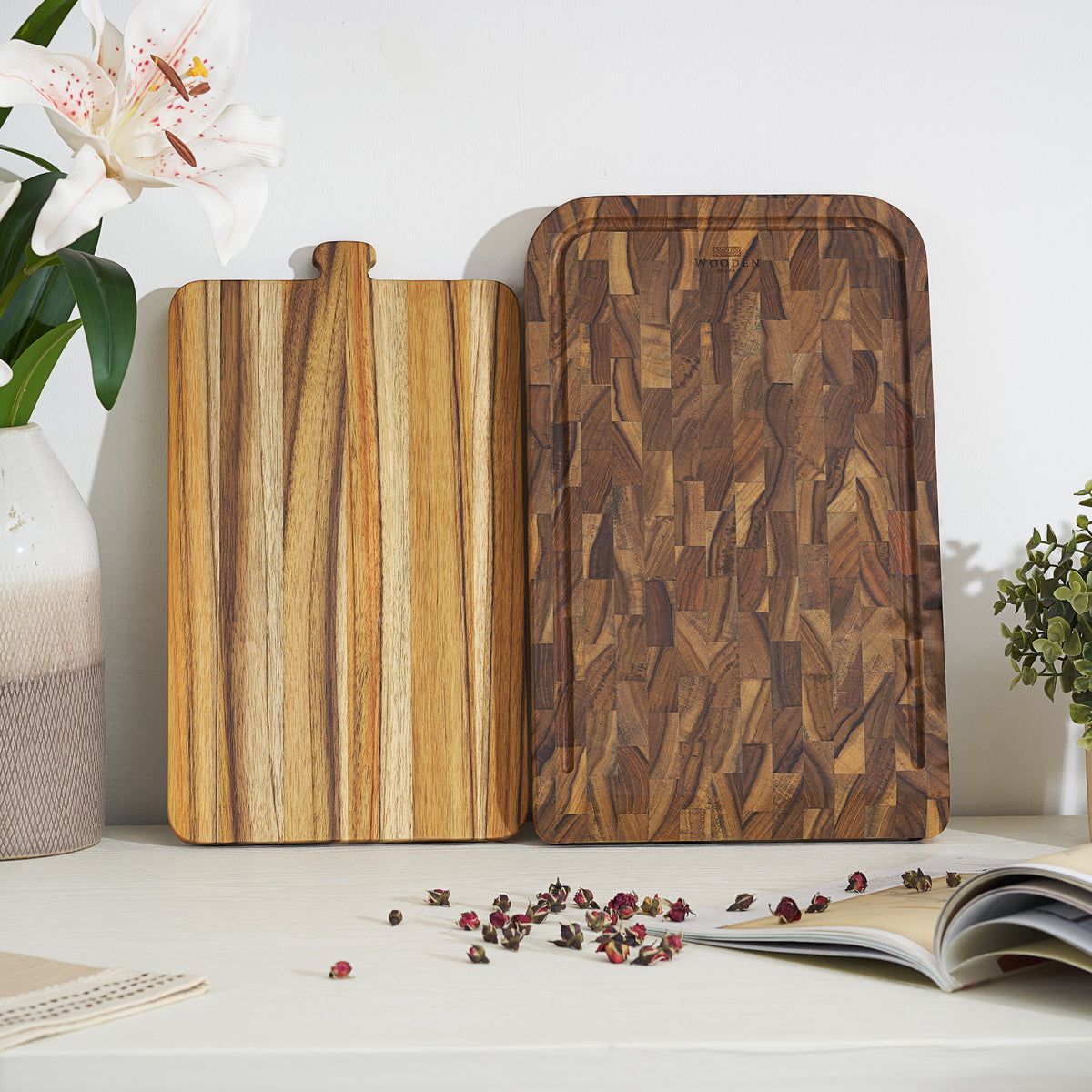
Edge grain is the most common cutting board construction. The boards are made by bonding long strips of wood together along their edges so when you look at the surface, you see parallel lines running the length of the board. Clean, linear, architectural.
How it performs: The hard surface holds up well to everyday chopping and slicing. It is slightly more resistant to knife marks than end grain, which makes it a practical choice for heavy prep work. It is also easier to sand and resurface if the surface develops wear over time.
The trade-off: Because the knife hits the surface of the wood fibres rather than between them, edge grain boards can show cut marks more visibly than end grain alternatives. They are durable but they show their use.
Best for: Daily prep work, cooks who want a board that stays looking tidy, kitchens where function comes first.
What Is End Grain?
End grain boards are built differently. Here, the wood pieces are oriented so that the cut surface shows the ends of the wood fibres which is the cross-section you'd see if you looked at a freshly cut log. The surface is a mosaic of small squares or rectangles, each one a different shade as the grain catches the light.
How it performs: This is where end grain earns its reputation. When a knife cuts into an end grain surface, the blade passes between the wood fibres rather than across them, which means the fibres close back after each cut, giving the board a natural self-healing quality. Over time, end grain boards develop a richness and depth that edge grain simply cannot replicate. They are also gentler on knives. Chefs who care about their blades tend to reach for end grain.
The trade-off: End grain boards require more wood and more labour to produce. They are heavier and thicker and they need more regular oiling to prevent the exposed fibres from drying out. They earn their price.
Best for: Serious home cooks, knife enthusiasts, those who want a board that develops character with age.
What Is Herringbone (Fishbone)?
Herringbone, sometimes called fishbone construction is where function and craft become art. Instead of parallel strips, pieces of wood are arranged at 45-degree angles, creating a repeating V-shaped pattern across the board's surface. The result is striking. Each row mirrors the next. The grain catches the light differently depending on how you look at it.
"At Wooden Decor, this is the construction we are most proud of. Our hand-laid teak fishbone pattern is built piece by piece, no two boards come out identical, because no two pieces of teak are the same. The grain shifts. The tone shifts. That variation is the point."
How it performs: Herringbone boards combine the structural benefits of edge grain, a firm, reliable cutting surface with an aesthetic quality that makes the board as much a piece of decor as a kitchen tool. Our boards are crafted from recycled teak, a wood naturally high in silica and natural oils, which means the surface resists moisture, bacteria, and warping without needing constant maintenance.
The trade-off: Herringbone boards require skilled craftsmanship to produce well. The angles must be precise. The joins must be clean. When done right, it holds together for years. When done quickly, it does not.
Best for: Cooks who want something beautiful enough to stay on the counter, gift buyers who want something that will be remembered, anyone who believes a cutting board should earn its place in the kitchen.
Side-by-Side: Which Construction Is Right for You?
| Edge Grain | End Grain | Herringbone | |
|---|---|---|---|
| Surface feel | Smooth, linear | Tactile, mosaic | Patterned, visual |
| Knife friendliness | Good | Excellent | Good |
| Durability | Very high | High (with care) | Very high |
| Maintenance | Low | Moderate | Low to moderate |
| Aesthetics | Clean, modern | Classic, rich | Artisan, distinctive |
| Weight | Medium | Heavier | Medium to heavy |
| Best use | Daily prep | Heavy chopping | Prep, serving, display |
A Note on Material
Construction matters. But so does what the wood is made from.
Teak is one of the few woods used for cutting boards that brings its own natural advantages to the table — literally. It is dense, naturally oily, and resistant to moisture without needing constant maintenance. It does not warp easily. It does not absorb odours. And it develops a patina over time that makes a well-used teak board more beautiful than a new one.
At Wooden Decor, every board whether edge grain, end grain, or herringbone, is made from recycled teak. Each piece is selected for its grain, its density, and its character. That is not a marketing claim. It is the foundation of how we make things.
The Final Word
There is no wrong answer here. Edge grain, end grain, and herringbone each have their place in a well-equipped kitchen. What matters is knowing the difference — so when you bring one home, you know exactly what you are choosing and why.
If you are looking for a board that works hard and looks beautiful doing it, teak herringbone is where we would start. But then, we might be biased.